
Bonus content from AHA’s 2026 issue of Mosaic magazine
Birmingham, AL | September 8, 2026
Mosaic Magazine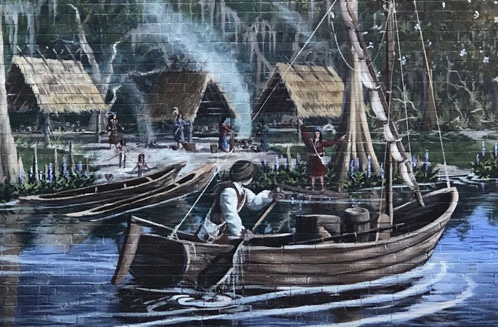
The following is a companion piece to an essay published in AHA’s 2026 issue of Mosaic, “Revolutionary Travelers through Creek Country,” by Kathryn H. Braund, Ph.D. The insights below further illustrate the Native land of 1776 that would eventually become Alabama.
By Bill Finch
For a brief time in the eighteenth century, much of the land we know now as Alabama was a place of no nations. The nations that had shaped it for thousands of years — the Alabama and Koasati, the Choctaws and Chickasaws, the Naniabi and Yuchi, and many others — had been devastated by disease, enslavement, and wars. But the new nations — the French, the Brits and Spaniards — still encroached timidly, clinging to the coast and major rivers.
The wilderness of Alabama, many believe, became wild again in ways that it had not been wild since humans built the first communities here, 15,000 years ago or so. The great pre-Columbian (pre-contact) Mississippian mound cities, densely populated and surrounded by what were essentially sprawling suburbs, were almost forgotten at the time of the nation’s founding. Aside from the small confederacy of Muscogee Creek communities that William Bartram encountered on his journeys from present-day Russell County down to Mobile, nature was filing in the gaps.
Canebrakes rapidly spread and reclaimed the river bottoms the First Nations had cleared for corn. Bison, by most accounts absent for many thousands of years, suddenly rebounded and flooded into the Black Belt prairies, the Huntsville basin grasslands, and some even into the pine savannas of South Alabama, free from the hunting pressure that had driven them west. Fires found their own way again through the landscape, no longer led by human burning practices, but following the lightning strikes that spread low flames from river to river, two or three times every decade in much of central and south Alabama, and almost as frequently in the north Alabama mountains and plateaus.
Bartram was perhaps the last explorer who could see the remnants of the old nations as the new nations were hot on his heels. He notes that bison, common a few decades before, seemed to have largely disappeared as the new settlers moved in. He describes the overgrown remnants of the old Choctaw peach plantations and abandoned villages along the Alabama river bluffs, even as he served as a sort of real estate agent for the new world to come, declaring the wild bluffs at Wetumpka “one of the most eligible situations for a city in the world.”
To the poets who read Bartram, Alabama seemed like some kind of tropical paradise or nightmare. Bartram’s descriptions of Alabama in 1776 helped inspire Samuel Taylor Coleridge’s fevered vision of Kubla Khan, even as it sent savage chills down the spine of William Wordsworth. It would have been as strange to us. Magnolias indeed spread “high as a cloud” overhead, as Wordsworth paraphrased Bartram, but the poet was a careful student of Bartram and his trips through Alabama, and notes the other vista of 18th century Alabama, “flowers that with one scarlet gleam” covered hundreds of miles.
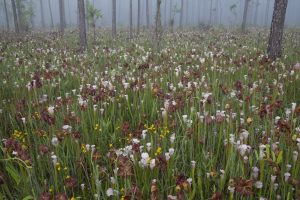
The interplay between grand forests, tall trees and extensive sunlit meadows and grasslands rich with flowers is almost impossible for the modern Alabamian to imagine. Most of Alabama’s forests weren’t really forests at all, but more like savannas, with widely spaced pines and grounds drenched in sunlight. Sunlit pitcher plant bogs and flowering flatwoods, a rainbow of flowers and carnivorous plants at all seasons, are now rare and precious. But in Bartram’s day they stretched nearly unbroken along the Gulf: you could walk from the outskirts of New Orleans to Tallahassee, and rarely leave one, as Alabama biologist George Folkerts once noted.
What passes for a modern Alabama river is now dull, flat, damned to silence. But the original Alabama rivers roared. Some of the world’s most spectacular gorges, waterfalls, and cascades passed through the heart of Alabama. The First Nations found much of their livelihood in that roar, yanking migrating redhorse, Alabama-run striped bass and shad, eel, and even giant sturgeon from the shoals. In much of Alabama, the fish have been buried with the shoals, and some of the most important fish in Bartram’s day may never be seen again.
Bill Finch is a writer, naturalist, and founding director of Paint Rock Forest Research Center. You can read more of Finch on Alabama’s natural history in his 2023 essay for Mosaic magazine.
By Mike Bunn
It is easy to forget that there was an America beyond the Atlantic seaboard in 1776. There were more than thirteen British colonies in North America when the United States declared its independence, though, and what became Alabama was at the center of one of them.
The city of Mobile then stood as perhaps the largest community in the colony of West Florida, a province stretching along the Gulf Coast from the Mississippi to the Chattahoochee Rivers that’s known as Great Britain’s forgotten “Fourteenth Colony.” Although its population was small, Mobile ranked as an important center for trade, diplomacy, and defense of a region the British hoped to develop into a thriving part of their empire.
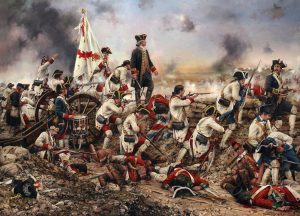
For all those reasons it became a key target in a military campaign between Spain and Great Britain that opened a new front in the Revolutionary War. Bernardo de Gálvez, governor of the Spanish colony of Louisiana, attacked West Florida during the war, ultimately securing for Spain possession of the technically “loyal” colony and changing the map of the Gulf Coast in the process.
Mobile fell to the Spanish after a short siege in March of 1780. A second battle for control of the Mobile Bay region was fought on the Eastern Shore in January of 1781, again won by the Spanish. These contests assisted Spain in securing control of West Florida, but equally important for American troops fighting elsewhere, they tied up a portion of the precious manpower and resources of the thinly-stretched British government.
Mike Bunn is director of Historic Blakeley State Park in Spanish Fort. He is also an AHA Road Scholar who offers a talk on this forgotten history of the Gulf South during the Revolutionary Era.
By Bobby Horton
We know that this land was filled with the songs and stomp-dance music of Muscogee Creeks and other nations. Surely, both English traditional tunes and Spanish folk songs were well known by those in the port city of Mobile.
For just about any settler of English descent, though, there’s one tune that just about everyone knew on the eve of the American Revolution.
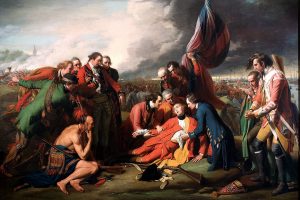
It’s a popular song from the French and Indian War called “Brave Wolfe,” about the British General James Wolfe, who was killed at the Battle of Quebec, a decisive British during the Seven Years’ War. He was a popular figure and the song went viral in the Colonies and surrounding territories.
Bobby Horton lives in Birmingham and is a multi-instrumentalist, composer, producer, and music historian. He is also an Alabama Humanities Fellow. To read more from Horton on Alabama music history, read his 2024 essay, “Our Stories are in the Music.”

Birmingham, AL
September 21, 2023
Birmingham / September 1, 2023 — Through the first half of 2023, the Alabama Humanities...
Birmingham, AL
July 5, 2022
[BIRMINGHAM / July 5, 2022] — In advance of The World Games in Birmingham, the...

Birmingham, AL
August 16, 2023
BIRMINGHAM / August 16, 2023 — A pair of Alabama natives, widely acclaimed for their...