Newsroom Category: AHA News

Major Grants return

(Above: Sacred Harp singing featured in an AHA-funded episode of the Alabama Folklife Association’s podcast series, Alabama Folk.)


The Alabama Humanities Alliance is once again set to offer Major Grants in support of humanities-rich public programming statewide. These grants offer up to $15,000 for eligible projects that bring Alabamians together to explore what makes us human — our shared history, literature, languages, art, archaeology, religion, philosophy, and more.

The timing of these Major Grants is intended to aid Alabama nonprofits, institutions of higher education, and governmental agencies in planning their public programming for 2027. AHA’s next two rounds of Major Grant deadlines are October 1, 2026, and February 1, 2027.

AHA’s updated grant guidelines are available now; AHA’s grant portal for Major Grant applications will open August 10. For full info on AHA grantmaking, visit alabamahumanities.org/grants.

“We are delighted to offer these Major Grants once again to support the many cultural and educational groups that rely on this funding,” says Chuck Holmes, AHA’s executive director. “AHA’s grantmaking is core to who we are and why we exist. This is how we help local communities learn more about the wider world around us, as well as the people, places, and stories that make Alabama home.”


About AHA’s Major Grants

AHA’s Major Grants often fund projects such as traveling exhibitions, oral history projects, lectures and conferences, cultural and literary festivals, teacher workshops, documentary films, and more. Competitive applications all share three essential elements: public participation, strong humanities content, and the direct involvement of humanities scholars.

These grants also often help connect the humanities to the arts, sciences, and beyond. In recent rounds of grantmaking, for instance, AHA has supported:

“We’re thankful for the Alabama Humanities grant that allowed us to bring national humanities speakers to our AI Symposium, exposing our community to a broad spectrum of ideas and establishing the U.S. Space & Rocket Center, and Alabama, as a leader in the AI discussion.”  -Nancy Noever, U.S. Space & Rocket Center, Huntsville


New guidelines for 2026

Interested applicants are strongly encouraged to read AHA’s updated guidelines in full. Key updates to this year’s guidelines for both Major and Mini Grants include:

The grant guidelines also feature three new resources for applicants:

In addition to the revised grant guidelines, applicants also have the opportunity to submit draft applications prior to each grant deadline – for feedback they can apply to their final application. Applicants can also set up a call to talk through eligibility and application questions with AHA’s grants director, Graydon Rust.


Funding history

This marks the first time in nearly a year and a half that AHA has been able to offer Major Grant funding for Alabama’s communities. In the spring of 2025, AHA experienced a disruption of its federal funding due to cuts directed by the U.S. Department of Government Efficiency — revoking funding that Congress had already appropriated for AHA and all other state humanities councils across the nation.

For more than 50 years, AHA has used federal funding to support its grantmaking. The arrangement is part of a longstanding federal-state partnership — created and annually renewed by Congress — that directs funding from the National Endowment for the Humanities to nonprofit and nonpartisan state humanities councils, like AHA. The goal is to empower grantmaking decisions at the state level, closest to the public programming being created by, and for, local communities.

“While our federal funding has yet to be restored to Congressionally directed levels, we are grateful that enough funds have started flowing so that we can again offer these vital grants,” says Holmes. “We know know how much Alabama’s communities rely on us. In a survey of our most recent Major Grant recipients, 90% noted that their work would not be possible without AHA’s support.”

The loss of federal funding also came at a critical time, given 2026 marked America’s 250th anniversary. Individual and institutional donors helped AHA sustain its monthly Mini Grants program (up to $2,500). Throughout 2026, AHA has prioritized funding projects that explore America’s founding history and principles and sparked community conversations on our shared past and future.

Still, the impact on Alabama’s communities is evident in AHA’s year-end 2024 and 2025 grantmaking numbers:

Grants awarded statewide:

Community events and public programs funded:

As another AHA grant recipient put it before last year’s pause in Major Grants:

“AHA support is the difference between many good and worthwhile programs happening or not happening in our state.”  -Mike Bunn, Historic Blakeley State Park, Spanish Fort


About the Alabama Humanities Alliance
Founded in 1974, the nonprofit and nonpartisan Alabama Humanities Alliance has served as a state affiliate of the National Endowment for the Humanities. Through AHA’s grantmaking and public programming, we promote lifelong learning, impactful storytelling, and civic engagement. We believe the humanities can bring Alabamians together and help us better understand the communities we call home.
Many Voices, One Nation

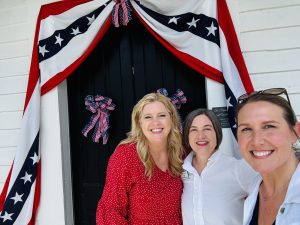
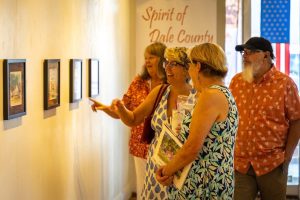
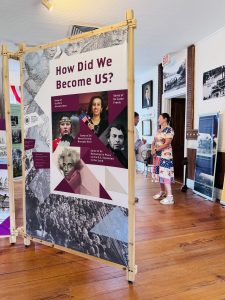
One week ahead of the nation’s 250th anniversary, the Alabama Humanities Alliance celebrated the openings of a pair of in-state exhibits for Many Voices, One Nation. The openings took place in the communities of Ozark and St. Stephens, and a photo album is available on AHA’s Facebook page.

Many Voices, One Nation began as a permanent exhibit on display at the Smithsonian’s National Museum of American History. For America’s 250th, AHA helped secure “starter kits” to create local versions of the exhibit. Now open, these exhibits highlight the people, places, stories, and events that have shaped our own Alabama communities from past to present.

“We are so grateful for our longtime partnership with the Smithsonian Institution and for the invaluable resources and experiences this partnership generates for the people of Alabama,” says Chuck Holmes, AHA executive director. “Especially right now, as we celebrate America’s semiquincentennial, this is a special opportunity see how the stories of Alabama tie into the larger narrative of American history.”

Washington County

On June 26, the Washington County Museum and the St. Stephens Historical Commission partnered to debut Many Voices, One Nation: Alabama’s First County as its locally customized exhibit, at the Old Washington County Courthouse in St. Stephens Historical Park. The exhibit is open daily through July 5, from 2-6pm, before moving to a different schedule hrough 2027.

Washington County’s exhibit and accompanying programming address local and national themes of expansion, freedom, inclusion, equality, migration, negotiation, and transformation. It explores the history of the U.S. and Washington County through the lens of our people — those who were here, those who came by force, and those who came seeking new beginnings.
Dale County


Over in Ozark, the Dale County Council of Arts & Humanities worked with community members and Smithsonian staff to curate its local exhibit, Many Voices, One Nation: Voices of Dale County in the Wiregrass. The exhibit opened on June 28 and will remain on display through August 8 at the Dowling Museum | Ann Rudd Art Center. The exhibit will then travel to venues across the Wiregrass through 2027.

At the exhibit’s opening, the community also celebrated an exhibition of artwork that’s featured in the new book, Spirit of Dale County: Celebrating Two Hundred Years, by Helen Taylor Andrews and Carol Luckfield. The project was spearheaded by Diane Clouse, a retired educator and performing arts professional who is also a member of AHA’s board of directors.
Many Voices exhibit info

St. Stephens:
Old Washington County Courthouse
Tuesdays and Thursdays
10am-2pm
Through 2027
washcoalhistory.com

Ozark:
Dowling Museum | Ann Rudd Art Center
Wednesday-Saturday
11am-3pm (5pm on Thursdays)
Through August 8, 2026
ruddartcenter.org


Support for this exhibit

For three decades, the Alabama Humanities Alliance has partnered with the Smithsonian’s Museum on Main Street to bring more than a dozen national exhibits to the state, touring 67 towns – and counting. The Many Voices, One Nation starter kit is an America at 250 project, made possible thanks to our local host partners and many individual and institutional donors, including the Alabama USA Semiquincentennial Commission, Ford Foundation, Wiregrass Foundation, ALA-TOM RC&D Council, and Wiregrass RC&D Council.

For more on Many Voices, visit alabamahumanities.org/many-voices-one-nation.


AHA and America at 250

Many Voices, One Nation is just one of many ways that the Alabama Humanities Alliance is helping Alabamians commemorate this milestone year. Among AHA’s 250 highlights this year:

Grant offeringsavailable statewide, to help Alabamians reflect on America’s founding and spark community conversations

250 Road Scholars presentations for communities across the state, highlighting America’s founding era

-Americans, a Smithsonian traveling exhibit opening in the fall that will visit Atmore, Wetumpka, Florence, Scottsboro, and Foley

-Alabama Colloquium series this fall, celebrating the diverse music of Alabama and honoring scholars who elevate our nation’s history and ideals

-250-themed issue of Mosaic magazine, exploring our past for the sake of our future

Healing History convening this fall that aims to bring Alabamians together to learn from our past

-Specially themed Alabama History Day 2026 state contest hosted at American Village

For more on all things 250, check out AHA’s America at 250 flyer.

Alabama at National History Day

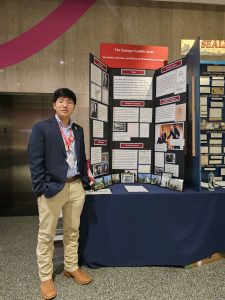
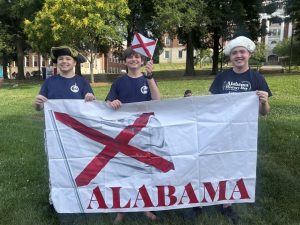
This week, AHA’s 2026 Alabama History Day winners traveled to Maryland and Washington, D.C., to participate in National History Day, June 14-18, 2026. Students competed with their middle school and high school counterparts from around the country, and represented our state poise, passion, and creativity.

“National History Day is always such a rewarding payoff for the students who place at our statewide contest,” says Idrissa N. Snider, Ph.D., AHA’s Alabama History Day coordinator. “This was a sharp, and kind, group of students and they represented our state with pride. We are so grateful to the parents who supported them, and to the brilliant teachers who work with these students on their projects and help prepare them for these competitions.”

In addition to the competition itself at the University of Maryland, the week also gave participants the chance to tour Washington, D.C. Alabama’s students visited Smithsonian museums, watched the U.S. Senate in session, and met with Senator Katie Britt, whose staff once again arranged a fascinating tour of the U.S. Capitol building for Alabama’s young historians. Some students and teachers also met with their own members of Congress to share how much History Day means to them, including with Rep. Robert Aderholt and Rep. Shomari Figures.

See an Alabama History Day 2026 photo album!


National recognition

Several Alabama students shined on the national stage:

Isaac Livingston, Westminster Christian Academy, Huntsville

Outstanding Affiliate Winner, Senior Division

“Yellowstone: A Wilderness Revolution” (Website)

Landon Nguyen, Clark-Shaw Magnet School of Math, Science, and Technology, Mobile

Outstanding Affiliate Winner, Junior Division

“Threads Bounding the World: How the Silk Road Revolutionized Global Trade” (Exhibit)

Yeonwoo Seok, Auburn High School

Smithsonian Showcase Selection, National Museum of American History

“The Tuskegee Syphilis Study: Revolution, Reaction, and Reform in Medical Research Ethics” (Exhibit)

Cassie Williams, Denton Magnet School of Technology, Mobile

Smithsonian Showcase Selection, Smithsonian’s National Museum of African American History and Culture

“The Voyage of the Clotilda: Ocean of Tears” (Documentary)


Looking ahead

National History Day closes out the 2025-2026 History Day season, which was themed around “Revolution, Reaction, Reform in History,” an apt selection given America’s 250th anniversary this year. AHA’s state contest took place at American Village in April.

Our thanks to AHA’s sponsors, partners, and schools statewide who make Alabama History Day possible, including the State of Alabama and Alabama Commission on Higher Education for their financial support.

The theme, contest dates, and details for Alabama History Day 2027 will be revealed later this summer. To learn more about Alabama History Day, visit alabamahumanities.org/alabama-history-day.

About the Alabama Humanities Alliance
Founded in 1974, the nonprofit and nonpartisan Alabama Humanities Alliance has served as a state affiliate of the National Endowment for the Humanities. Through AHA’s grantmaking and public programming, we promote lifelong learning, impactful storytelling, and civic engagement. We believe the humanities can bring Alabamians together and help us better understand the communities we call home.
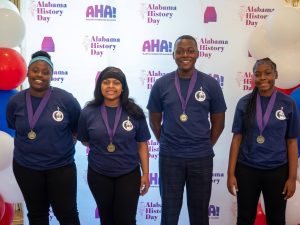
Students become the teachers at Alabama History Day

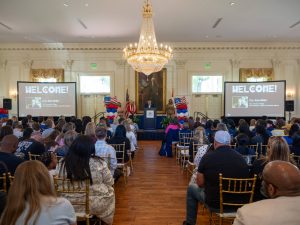
April 13, 2026 — History is always present at Montevallo’s American Village, where Alabamians learn about America’s founding history and the responsibilities of citizenship. On April 9, a different kind of history was made here — by students who came from across the state to present their own historical research, at AHA’s Alabama History Day 2026.

These middle school and high school students came from Magnolia Springs and Mount Vernon, Athens and Madison, and from Auburn, Tuscaloosa, and many points in between. And they came prepared.

Throughout the 2025-2026 school year, History Day participants chose their own topics and conducted primary research to shape new historical arguments. These students then transformed from historians into artists, filmmakers, actors, writers, and web designers, as they dreamed up creative ways to share their research.

“That’s such a great part of this process,” says Ginger Golson, a history teacher at Fairhope High School. “Students like to be able to choose the things that they want to do and the way that they want to do it. And when they’re interested in what they’re studying, they’re more engaged and they produce better work. It gets them engaged in learning on their terms.”
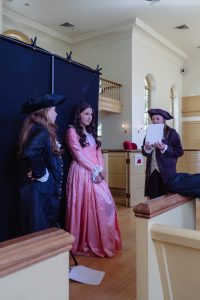
On April 9, competitors presented exhibits, documentaries, websites, papers, and dramatic performances to judges inside replicas of some of America’s most historic, Colonial-era buildings — such as Philadelphia’s Independence Hall, George Washington’s Mount Vernon, and Williamsburg’s Bruton Parish Church. Once finished, students had the chance to experience all American Village offers — from historical storytelling by Colonial actors to a replica Oval Office, exhibits at the National Veterans Shrine, and much more.

Alabama History Day winners were announced at an exuberant awards ceremony at day’s end. First- and second-place finishers are now eligible to advance to National History Day this summer in Maryland and Washington, D.C.

Walter D. Ward, Ph.D., is a professor and chair of History at UAB. At Alabama History Day, he served as both a judge and as a sponsor presenting UAB’s Civil Rights History Award.

“Alabama History Day is such a positive experience for students,” Dr. Ward says. “Students don’t get many opportunities to be experts, but on Alabama History Day, they were the experts, and I was the student. Experiences like these give students confidence that they can do research and communicate what they learned. These are exactly the kinds of skills that will benefit them no matter what career they eventually seek.”


More on Alabama History Day 2026


Topics run the gamut of history

Of the 120-some projects that made it to the state contest, topics ran the gamut from local to state, national, and international topics of history. All connected to this year’s theme, inspired by the 250th anniversary of America’s Declaration of Independence, “Revolution, Reaction, Reform in History.”

Some projects hit America’s founding history head on, including “Alexander Hamilton: Architect of America”; “Survival and Sovereignty: Alabama Native Americans through Revolution, Reaction, and Reform”; “The American Revolution and the Boston Tea Party.”
Other projects focused on Alabama history right in students’ own backyards, such as “Mosquitoes, Medicine, and the Man from Mobile: Dr. William Gorgas and the Fight for Global Health”; “The Space Race in the Rocket City’s Engineering Revolution”; “The Republic of West Florida: A Hidden Chapter in American History.”

And some projects explored either American history or global stories from the past. For example: “The Indochina Migration and Refugee Assistance Act of 1975”; “The Day the People Took the Bastille”; “The Ghost Girls: How Radium Changed American Businesses Forever.”

No matter the subject, all students had to identify primary sources and then interpret their findings for volunteer judges who work as historians, educators, lawyers, and authors.

“The most important lesson we’re trying to teach is how you go about doing research with integrity,” says Chuck Holmes, executive director of the Alabama Humanities Alliance. “They have to find sources, build a bibliography, and learn how to tell a story — whether that’s through writing, film, performance, or whatever interests them.”


Recognizing student and teacher excellence

At Alabama History Day’s awards ceremony, student winners were recognized in a variety of project categories, and some students received special awards given out by historical and educational groups. These special award sponsors include the Interstate Character Council of Alabama, Alabama Public Television, and National Maritime Historical Society, among others.

A pair of educators were also recognized for their work throughout the 2025-2026 Alabama History Day journey. Laura Carter, a social studies teacher at New Century Technology High School in Huntsville, was named Outstanding AHD Teacher of the Year. Matthew Spivey, academic supervisor for social studies at Mobile County Public Schools, was honored as Outstanding AHD Supporter of the Year.

Students and teachers alike are already looking forward to Alabama History Day 2027, which comes with a theme of “Innovation in History: Impact, Influence, Change.”

And everyone left American Village last week with an inspiring charge, given to them by Col. Alan Miller, the CEO of American Village and a Board member with Alabama Humanities. Miller shared that what students accomplished through Alabama History Day is a beginning, not an end. And they have history itself to inspire them to even greater goals in the future.
“If you look, you will find the figures in history who speak to you, those who struggled and failed and got back up,” Miller shared. “Draw strength from them and let them remind you that greatness is not reserved for those who are perfectly prepared. It is earned by those willing to grow.

“Failure is the only thing that comes easily. Everything else, everything worthwhile, requires effort, discipline, and persistence. You have demonstrated that — not just today but in all the work and effort you put into your projects leading up to today.

“Thank you for the work you’ve done to truly engage with history. Because you didn’t just study it. You studied it to understand it. I hope you were able to see yourself in it. And hopefully you recognized that your own moment, ready or not, will come. And when it does, I hope you’ll be willing to do what Washington did, what Lincoln did, what Martin Luther King Jr. and Rosa Parks did. I hope you will recognize your moment and step forward into it.”


About Alabama History Day
Alabama History Day is a year-long program and the Alabama Humanities Alliance presents it as a state affiliate of National History Day. The program helps students become passionate about the past and become confident, curious learners for the future. History Day also provides teachers with a dynamic project-learning tool for the classroom. The competition is open to all public, private, and homeschool students in grades 6-12. Learn more at alabamahumanities.org/alabama-history-day.

Funding for Alabama History Day comes from the State of Alabama through the Alabama Commission on Higher Education. Alabama History Day 2026 was presented in partnership with the American Village Citizenship Trust and the Alabama USA Semiquincentennial Commission.
Additional research partners and award sponsors include the Alabama Department of Archives & History, Alabama Historical Association, Alabama Public Television, Auburn University at Montgomery, David Mathews Center for Civic Life, Interstate Character Council of Alabama, National Maritime Historical Society, Sons of the American Revolution’s Alabama Society, Troy University, University of Alabama at Birmingham, University of Alabama in Huntsville, University of Montevallo, and William Wayne Smith Foundation.

About the Alabama Humanities Alliance
Founded in 1974, the nonprofit and nonpartisan Alabama Humanities Alliance has served as a state affiliate of the National Endowment for the Humanities. Through AHA’s grantmaking and public programming, we promote lifelong learning, impactful storytelling, and civic engagement. We believe the humanities can bring Alabamians together and help us better understand the communities we call home.

AHA welcomes two new Board members

February 4, 2026 — The Alabama Humanities Alliance welcomes Nick Lawkis, of Mobile, and Barney Lovelace, J.D., of Decatur, to its volunteer Board of Directors. Lawkis and Lovelace were appointed to the Board by Governor Kay Ivey; gubernatorial appointees comprise up to 25% of AHA’s Board.

“We are grateful to Gov. Ivey for appointing Nick and Barney to join our Board of Directors,” says Chuck Holmes, AHA’s executive director. “Their distinct areas of expertise — not to mention their passion for Alabama’s history, law, arts, and culture — will help AHA continue to serve this state well through the humanities.”

Governor Ivey’s appointments became official on January 28. Lawkis and Lovelace will be introduced at AHA’s first Board meeting of the year on February 6.


Nick Lawkis
Nick Lawkis

As vice president of government relations for the University of South Alabama, Nick Lawkis covers all aspects of local, state, and federal relations, including for the University and its health system, USA Health. With a total annual revenue of over $2 billion and nearly 12,000 employees, the university is one of the largest employers in the Gulf Coast region.

In addition to his duties at South Alabama, Lawkis serves as chair of the Council of University Governmental Affairs Representatives, representing all four-year universities in Alabama. His professional contributions have earned him distinguished recognition, including being named to Mobile Bay Magazine’s “40 Under 40” and graduating from the Alabama Leadership Initiative program.

“It is an honor to receive this appointment from Governor Ivey to join the good work of the Alabama Humanities Alliance,” Lawkis says. “After visiting with Chuck and learning even more about the mission and impact of AHA statewide, I’m thrilled to lend my support.”

Lawkis is married to Kim (Proctor) Lawkis, chief operating officer of Feeding Alabama. They have two children, who they enjoy taking to a pair of nearby historical sites at the USS Alabama and Fort Gaines on Dauphin Island.


Barney Lovelace
Barney Lovelace

A Brewton native and longtime Decatur resident, Barney Lovelace has spent his career deeply involved in both the legal profession and civic engagement. He is currently senior partner at Harris, Caddell & Shanks, P.C., the oldest law firm in Decatur. He has served as president of the Morgan County Bar Association and is a graduate of Leadership Alabama, Class XIX.

Lovelace has served on the numerous boards, including the Decatur-Morgan County Chamber of Commerce and as chair of the Decatur Morgan Hospital Foundation. He and his wife Noel are also dedicated supporters of the arts and humanities in Decatur, serving as patrons of the Princess Theatre, the Carnegie Visual Arts Center, River Clay Fine Arts Festival, and the Alabama Center for the Arts.

“I’m excited to join the board of the Alabama Humanities Alliance because I believe stories matter,” Lovelace says. “They’re how we know where we come from and how we figure out where we’re headed. Like the land and traditions we pass down, our history and culture need care if they’re going to last. AHA does that kind of good, steady work, and I want to help make sure Alabama’s stories are kept alive and told right.”


2026 Board leadership

Robbie McGhee, of Atmore, will serve his second year as chair of AHA’s board of directors in 2026. McGhee is an enrolled member of the Poarch Band of Creek Indians, and has been an advocate for Native American issues at all levels of government. He is in his fifth term on the Poarch Band of Creek Indians Tribal Council.

The rest of AHA’s 2025 board’s leadership includes:


Meet AHA’s full Board of Directors.


Thanking former Board members

In 2025, four Board members completed their service on AHA’s Board of Directors. The Alabama Humanities Alliance, its staff, its grant recipients, and Alabamians statewide were beneficiaries of the good work of:


About the Alabama Humanities Alliance
Founded in 1974, the nonprofit and nonpartisan Alabama Humanities Alliance has served as a state affiliate of the National Endowment for the Humanities. Through our grantmaking and public programming, we promote lifelong learning, impactful storytelling, and civic engagement. We believe the humanities can bring Alabamians together and help us better understand the communities we call home.

Keeping the humanities alive in 2025

Above: An AHA grant funded artist interviews and talks at Dothan’s Wiregrass Museum of Art.


January 21, 2026 — Last May, a literacy group brought an award-winning children’s author (and hundreds of her books) to Birmingham elementary schools — fostering a love for reading and learning in local students.

Last August, the Alabama Genealogical Society’s summer seminar in Gadsden gathered folks from around the state to learn how to research their family history — and connect their own stories to Alabama’s.

And in December, a church in Mobile launched an effort to publicly document the history of Alabama’s Presbyterian women — highlighting their contributions to our state’s culture and literature.

What do these community projects have in common? They were among 36 statewide recipients of grant funding from the Alabama Humanities Alliance in 2025.

“Our AHA grant award was vital to the success of our festival and strengthened our museum’s ability to serve our community through arts and cultural programming,” says Kelly McKenzie, of the Monroe County Heritage Museum, which received an AHA grant for its 2025 Monroeville Literary Festival.

“This funding allowed us to offer meaningful, engaging experiences that would not have been possible otherwise — especially in a rural area with limited access to arts resources. Without AHA support, many of our initiatives would simply not reach the scope or quality our audiences deserve.”


Meet AHA’s 2025 grantees.


Grantmaking in a challenging year

AHA’s grantmaking declined sharply in 2025, due to an unexpected loss of federal funding that occurred in April. Following a nearly two-month pause, support from individual and institutional donors helped AHA bring back its Mini Grants for the rest of the year.

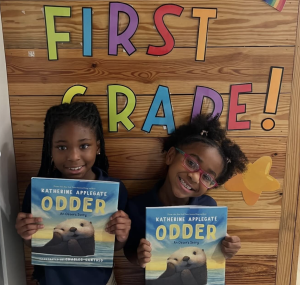
Students received books from an AHA-funded literacy program led by STAIR Birmingham.

In total across 2025, AHA awarded just over $83,000 in Mini Grants to fund 36 public projects. In contrast, with level funding in 2024, AHA was able to fund 65 public programs across the state, providing $380,000 in Mini, Major, and Media Grants combined.

“For more than 50 years, AHA’s grantmaking has been the backbone of our work across Alabama,” says Chuck Holmes, executive director of the Alabama Humanities Alliance. “These grants support locally developed public programs that help Alabamians discover more about our shared past, and consider our present and future, together. It pained us to have less funding available this past year for grantmaking. We know it hurt local nonprofits and cultural institutions statewide who rely on us for this type of support.”

Indeed, AHA remains the primary source of funding for humanities-based public programming in the state. In a 2024 survey of our grant recipients, 90% said their public programming would not have been possible without AHA’s support.

AHA grant recipients include community cornerstones and education-based nonprofits, such as libraries, museums, historic sites and historic societies, universities, arts and culture organizations, literary organizations, chambers of commerce, and more. Artists, filmmakers, and other creatives often rely on AHA Media Grants, too, for producing Alabama-focused documentaries, podcasts, and other digital media.

“While we wish our capacity had been greater in 2025,” says Holmes, “we are beyond grateful to our donors who helped us survive 2025 and helped us keep supporting humanities-rich public programming in as many communities as possible.”

In Gadsden for the Alabama Genealogical Society’s AHA-funded 2025 summer seminar.

AHA-funded local programming in 2025 included oral history projects; literary and film festivals; literacy programs; folklife celebrations; religious studies; moderated conversations on art, music, and books; explorations of Alabama’s natural history and civil rights legacy; and local storytelling via documentaries, podcasts, and more.

AHA’s Mini Grants, which offer up to $2,500 for humanities-rich programming across the state, are once again available in 2026; Major Grants (up to $10,000) and Media Grants (up to $15,000) remain suspended, as AHA seeks to secure sustainable, long-term funding for these opportunities.


2025 grant-funded project examples

Alabama Coal Miners Digital Archive
The University of Alabama | Tuscaloosa
This project gives Alabama coal miners the chance to share their memories — and artifacts — as part of a project to preserve our state’s coal mining history. Organized by the University of Alabama’s Department of History, this project will also give miners the chance to scan, and preserve, artifacts like photos, letters, mining lamps, helmets, lunch buckets, and more.


Alabama Folk Podcast, Season Four
Alabama Folklife Association | Statewide (Mobile)
Alabama Folk explores Alabama’s many cultures and traditions and engages statewide audiences in Alabama folklife. The podcast features deep interviews with Alabama artists who carry on traditions passed down through the generations or shared in community. Season Four showcases artists diverse in experience, artform, and geography.


Deep Roots, Strong Souls: Anniston’s Black Heritage Documentary
Public Library of Anniston-Calhoun County | Anniston
The history of Anniston runs deep, but often overlooked are the contributions of Anniston’s Black population in the growth of the city. The goal of this project is to create a documentary utilizing Library resources (photos, oral histories, research materials) and have an experienced videographer, Neal “Buddy” Vickers, create a documentary on the subject to be shown at the Library as a program during February 2026 for Black History Month.


InChoir: Conversations about Choral Music, the Arts, and Life- Season Three
Troy University | Troy
The podcast, “InChoir: Conversations about Choral Music, the Arts and Life,” goes directly to choral composers to learn how they explore sound, universal texts, and shared human experiences in their choral compositions — to hear the “stories behind their songs.” AHA funding assists in the production of Season 3 and helps expand our outreach in social media and print publications within the Music Education and/or Choral Music fields in Alabama and beyond.


The Invisible Hand of Diplomacy: Shaping Our World
Global Ties Alabama | Huntsville
Celebrating 60 years of service, Global Ties Alabama partners with the Association for Diplomatic Studies and Training to bring an engaging U.S. diplomatic exhibit to Alabama. The exhibit highlights key diplomatic moments in U.S. history, while a complementary “Century of Service” presentation by a seasoned Foreign Service Officer delves into the personal — often unheard — stories of diplomats, revealing the power of human connection in shaping our world.


Lunch & Learn Series on History of Hartselle and Morgan County
Hartselle Historical Society | Hartselle
The Hartselle Historical Society’s 2026 Lunch & Learn Series will bring in knowledgeable local historians to speak about the people, places, and events that have shaped this community. Presenters will include archivists, curators and directors of historical repositories, local educators and historians, businessmen, and members of founding families who will weave a picture of Hartselle’s history from before its official incorporation to the present.


Monroeville Literary Festival – 2025
Monroe County Heritage Museum | Monroeville
The Monroeville Literary Festival is a two-day event hosted by the Monroe County Heritage Museum. The 2025 festival features honorees Cassandra King and Suzanne Hudson. Visitors from across the state and beyond attend the event, notonly to meet authors and hear their stories, but also for the real Monroeville experience of walking in the footsteps of Monroeville’s famous authors. Visitors attend lectures, book reviews, workshops, and book signings.


Learn more about all our 2025 grant recipients.


About the Alabama Humanities Alliance
Founded in 1974, the nonprofit and nonpartisan Alabama Humanities Alliance has served as a state affiliate of the National Endowment for the Humanities. Through our grantmaking and public programming, we promote lifelong learning, impactful storytelling, and civic engagement. We believe the humanities can bring Alabamians together and help us better understand the communities we call home.

Remembering the Hon. Sally Greenhaw

Above: Judge Sally Greenhaw receives an honor at the 2022 Alabama Colloquium in Montgomery.


January 8, 2026 — The Alabama Humanities Alliance is mourning the loss of one of its longtime friends and most ardent supporters, the Hon. Sally M. Greenhaw, who passed away over the holidays at age 83.

Before she became a member of Alabama Humanities’ Board of Directors, Judge Greenhaw opened doors for women in state government and the judiciary. After graduating from the University of Alabama and Cumberland School of Law, she became the first female assistant attorney general in Alabama. Judge Greenhaw would go on to become the first woman elected as a Montgomery County district court judge, too. Later, she was elected (and long reelected) as a circuit court judge. Judge Greenhaw also served in countless volunteer and leadership positions, including with the Alabama Council on Substance Abuse, Family Guidance Center, Leadership Montgomery, and Leadership Alabama.

Of course, those here at AHA cherish her unfailing support of the humanities, and her belief in the power of the humanities to enlighten and enliven Alabama. Judge Greenhaw provided leadership during a key period of growth and evolution for AHA, and she became one of AHA’s most steadfast donors, making key programs and events possible statewide, such as our now-annual Alabama Colloquium.

“Judge Greenhaw was a champion for the humanities, and I was honored to serve on the board of the Alabama Humanities Alliance with her for the better part of a decade,” says Trey Granger, a past chair for AHA and the Clerk of Court for the United States Court for the Middle District of Alabama.

“We developed a close bond during our tenure and shared many laughs and swapped stories, most of them Montgomery-based, when we were together for meetings. Judge Greenhaw’s quick dry wit was her trademark and her passion for the arts and humanities serves as an example to all of us. Thanks be to God for, and long live, Sally Greenhaw.”


Beyond the court

AHA’s staff and Board members had the pleasure to know Judge Greenhaw long before her own Board service (2014-2021). Her husband Wayne was a Board member prior to Sally and those who knew them treasured knowing them as a couple.

The Hon. Myron H. Thompson was one of those who got to know the Greenhaws well through their careers in the judiciary. Judge Thompson is United States District Judge for the Middle District of Alabama and an Alabama Humanities Fellow.

Judge Sally Greenhaw and Judge Myron H. Thompson.

“Judge Greenhaw was one of a kind,” Thompson says. “She and Wayne lived life in a beautiful way that championed all that is good in this world. They completed each other, and those of us who called them friends were enriched to have been in their circle. Our court took Sally’s oral history a few years back and I am delighted that we have a window into the wonderful world of Sally and Wayne, and that it will be shared with future generations of Alabamians.”

“Wayne and Sally had a great commitment to making Alabama a better place for all our citizens,” agrees Reggie Hamner, a member of AHA’s Board with Sally. “Alabama Humanities was a prime vehicle and a beneficiary of their talents. Sally was a trailblazer in being elected one of the first female trial judges in Alabama, and she and Wayne were a team for the betterment of Alabama through the aspirations of the humanities.”

As so many know, Wayne was a prolific and powerful writer who won numerous awards for his books, including the Harper Lee Award for Alabama’s Distinguished Writer. After his passing in 2011, Alabama Humanities established the Wayne Greenhaw Service to the Humanities Award. The honor recognizes individuals who have made substantive contributions to the work and mission of the Alabama Humanities Alliance, and in service of the public humanities generally in Alabama.

Sally received the honor in 2022 during our Alabama Colloquium in Montgomery, when AHA also honored Bryan Stevenson and the late John Lewis as Alabama Humanities Fellows.

In her brief and typically humble remarks, Judge Greenhaw shared: “Just to be on the same program honoring John Lewis and Bryan Stevenson, that in itself is an honor. These two gentlemen embody not only the best of what the humanities are, but what the humanities can be.”

AHA is forever grateful for the influence of both Sally and Wayne on our work, and we smile knowing that they are reunited once again.

To learn more about Sally and Wayne, watch the video referenced by Judge Thompson — an oral history of the Greenhaws’ lives and legacies, produced by the U.S. District Court’s Middle District of Alabama.

Commemorating America at 250

October 15, 2025 In 2026, Americans will celebrate the 250th anniversary of our country’s first founding document, the Declaration of Independence. To commemorate, the Alabama Humanities Alliance will offer an extra slate of grants and programming in 2026, helping Alabamians place the past in context, consider our present, and imagine what our shared future might look like.

Among AHA’s “250” highlights: Grant offerings to help Alabamians reflect on America’s founding and connections to today; two new Smithsonian traveling exhibits; American Village will host the 2026 edition of AHA’s annual Alabama History Day contest; new Road Scholars will present talks related to America’s founding era; and a fall Healing History convening aims to bring Alabamians together.

“We are very excited to bring an Alabama perspective to commemorations of our nation’s 250th anniversary,” says Chuck Holmes, AHA’s executive director.

“This work builds on what we do year in and year out — supporting opportunities for lifelong learning, impactful storytelling, and civic engagement. We know that when folks engage with history, culture, community, art, folklore, and storytelling — we learn more about who we are, where we come from, and what brings us together.”


AHA’s “America at 250” programming


A portion of the brand-new Smithsonian exhibit, AMERICANS, coming to Alabama in 2026-2027.


Share our “AHA: America at 250” flyer.


AHA’s 250 partners

None of these initiatives would be possible, of course, without the work of many partners across Alabama, many of whom are putting together incredible “America at 250” programming of their own.

Thank you to AHA’s initial 250 partners, including: American Village, Caroline Marshall Draughon Center for the Arts and Humanities, David Mathews Center for Civic Life, Dale County Council of the Arts and Humanities, Encyclopedia of Alabama, National History Day, Smithsonian Institution’s Museum on Main Street, and Washington County History Museum.

The Alabama Humanities Alliance is especially proud to be a partner organization for America250AL at American Village, the state’s designated Semiquincentennial celebration capitol. America250AL offers celebration grants, community toolkits, a Semiquincentennial Schools program, and an oral history effort called “Share Your Story.” To learn more about these offerings, and more, visit america250al.org.


Help make this all happen

Alabama Humanities remains committed to its Semiquincentennial commemorations, but AHA will need help from individuals and organizations across the state to make it happen. This is due to abrupt, and deep, federal cuts to AHA’s funding in 2025.
Since 1974, AHA has been part of a federal-state partnership to promote the arts and humanities across the United States. In that time, AHA has used federal dollars annually appropriated by a bipartisan Congress to support its statewide grantmaking and local programming in communities across Alabama.

In April of 2025, however, the U.S. Department of Government Efficiency (DOGE) terminated AHA’s longstanding partnership with the National Endowment for the Humanities, eliminating what amounts to two-thirds of AHA’s annual funding. Since then, we have been deeply grateful for support from individuals, corporations, foundations, and state lawmakers that has helped AHA preserve much (though not all) of our statewide offerings.


To support AHA’s 2026 programming, donate at alabamahumanities.org/support.


About the Alabama Humanities Alliance
Founded in 1974, the nonprofit and nonpartisan Alabama Humanities Alliance has served as a state affiliate of the National Endowment for the Humanities. Through our grantmaking and public programming, we promote lifelong learning, impactful storytelling, and civic engagement. We believe the humanities can bring Alabamians together and help us better understand the communities we call home.

Photo at top: Residents of Ozark, Alabama, gather for the opening reception of a Smithsonian traveling exhibit in 2024. For America’s Semiquincentennial, AHA will bring two new Smithsonian exhibits to the state in 2026, which will help Alabamians explore the rich and complex history of our nation. 

Road Scholar talks are back

September 16, 2025 — Five months after pausing its Road Scholars Speakers Bureau as a result of abrupt federal funding cuts, the Alabama Humanities Alliance has reopened the beloved program, through at least the rest of 2025. This reopening is possible thanks to recent donations, including another major gift from philanthropist Hugh F. Culverhouse Jr.

Since 1987, AHA’s Road Scholars have crisscrossed Alabama, providing fascinating talks and critical programming for local nonprofits across the state — libraries, senior centers, historical societies, churches, and more. Now, these community cornerstones can once again apply to bring a Road Scholar to their towns, with an eye toward 2026 public programming.

“The Road Scholars Speakers Bureau has been a vital part of our programming, especially for senior adults, for more than two decades,” says Mary Hamilton, director of the H. Grady Bradshaw Chambers County Library.
“With the variety and depth of topics available at an affordable cost to a public library, our patrons have enjoyed learning about history, sports, foodways, music, and so much more,” Hamilton shares. “I’m delighted that the Road Scholars program once again is available to bring insightful, entertaining, and educational programs to our community.”

Applications to host a Road Scholar will be considered on a monthly basis moving forward, with the first monthly deadline coming up October 1.

Learn more about our Road Scholars Speakers Bureau.


Why were Road Scholar talks paused?

AHA paused some of its grantmaking and programming in April after the U.S. Department of Government Efficiency (DOGE) terminated AHA’s longstanding partnership with the National Endowment for the Humanities — eliminating what amounts to two-thirds of AHA’s annual funding.

The cuts were unexpected. Since 1974, AHA has been part of a federal-state partnership to promote the arts and humanities across the United States. In that time, AHA has used federal dollars annually appropriated by a bipartisan Congress to support grantmaking and programming in communities across Alabama.

Since April, an outpouring of support from individuals, corporations, foundations, and state lawmakers has helped preserve the Alabama Humanities Alliance — and kept many of our statewide offerings afloat. That includes our current Smithsonian traveling exhibit touring six communities across the state; Alabama History Day for middle school and high school students; our Healing History initiative bringing Alabamians together; and a limited slate of AHA’s Grant offerings that support locally created humanities projects in towns statewide.

“Quite literally, none of our work is possible right now without support from individuals and organizations who believe in the power of lifelong learning and impactful storytelling,” says Chuck Holmes, AHA’s executive director. “AHA’s donors care about helping Alabamians connect with our past, with each other, and with the stories that illustrate the world around us.

“We’re grateful to offer our Road Scholars through at least the rest of this year, and we hope that future funding will enable us to extend this program into 2026, and beyond.”


AHA’s Road Scholars Speakers Bureau

Over the past five years, AHA’s Road Scholars have delivered more than 300 talks in communities large and small. In 2024 alone, more than 5,000 Alabamians gathered to hear a Road Scholar presentation.

The program is a vital source of community programming for local libraries, museums, historical societies, historic sites, and more. The Road Scholars program also serves more senior citizens than any other AHA offering, and senior centers often serve as a host venue for talks.

Road Scholar speakers include poets laureate, acclaimed storytellers, award-winning authors, artists and musicians, military veterans, woodworkers, printmakers, sportswriters, theatrical directors, cemetery experts, genealogists, and more.

Their talks cover the gamut of Alabama and American history, including:


And that’s just a small percentage of the 100-plus presentations developed by AHA’s roster of Road Scholars.

Michael Burger, Road Scholar

Michael Burger, Ph.D., is an AHA Road Scholar and a professor of history at Auburn University at Montgomery. His talks include presentations on the inspirations for the U.S. Constitution, a fascinating reconsideration of Cleopatra, and a look at the evolution of universities from the middle ages to modern times.

“It’s a blast to bring really interesting history to audiences looking for some enlightenment,” Burger says. “The idea is not to make history interesting, but to reveal how it’s interesting and why it matters today. And what’s as much fun for me is what comes after the talk: audience questions and discussion.”

For organizations interested in applying for a grant to host a Road Scholar, visit alabamahumanities.org/road-scholars. Applications will be considered on a monthly basis, with deadlines the first of each month.

Once scheduled, all Road Scholar talks are available to the public for free, and promoted on AHA’s online events calendar.


Additional resources for applicants:


About the Alabama Humanities Alliance
Founded in 1974, the nonprofit and nonpartisan Alabama Humanities Alliance has served as a state affiliate of the National Endowment for the Humanities. Through our grantmaking and public programming, we promote lifelong learning, impactful storytelling, and civic engagement. We believe the humanities can bring Alabamians together and help us better understand the communities we call home.

AHA’s 2025 grantmaking

Through the first half of 2025, the Alabama Humanities Alliance has awarded 14 grants across Alabama, totaling nearly $32,000 in support of locally created, humanities-rich public programming.

Projects funded include childhood literacy programs, oral history projects, civics education, literary festivals, documentary films, and explorations of Alabama art, music, and folklife. Grant recipients hail from Huntsville to Monroeville, Dothan to Anniston, and many points in between.

See below for examples of AHA-funded projects thus far in 2025.


Less funding for the humanities in Alabama

As happy as AHA is to have funded these projects, the organization’s overall grantmaking capacity is down significantly this year. For comparison, at midyear 2024 and 2023, AHA had already awarded $157,351 and $206,996, respectively, to Alabama nonprofits, colleges, and state and local agencies.

The reason?

On April 2, 2025, the U.S. Department of Government Efficiency terminated AHA’s 50-year partnership with the National Endowment for the Humanities — and, with it, two-thirds of AHA’s annual budget. For more than half a century, AHA had used federal dollars appropriated by a bipartisan Congress to support annual grantmaking — $13 million to local communities statewide since 1974.

This year, however, AHA had to fully suspend its grantmaking for two months, as it sought to stay viable and find alternative sources of funding for its grants, programs, and operations.

On May 19, AHA announced it was bringing back its monthly Mini Grants, which offer up to $2,500 each. AHA’s Major Grants (up to $10,000 each) and Media Grants (up to $15,000 each) remain on hold.

This restoration of Mini Grants was made possible thanks to the generous support of individuals, corporations, and foundations, including major gifts from Hugh F. Culverhouse Jrand from the Federation of State Humanities Councils with support from the Mellon Foundation.

“We were pleased to resume this support that helps thousands of Alabamians come together as they engage with the humanities in their own communities,” says Chuck Holmes, AHA’s executive director. “We missed offering these grants as much as our local partners missed the support.”

Indeed, in 2024, 90% of AHA’s grant recipients reported that their public programs and events would not have been possible without funding provided by the Alabama Humanities Alliance. Over the past five years, AHA has received 607 grant applications — $5.9 million in total requests.

“We’re acutely aware that there’s a host of local nonprofits, universities, and state and local agencies out there who rely on us,” Holmes says. “So, while we’re thankful to once again offer our Mini Grants, we know the need goes beyond that. And the reality is that we don’t know what our ability will be to serve Alabamians in 2026, and beyond.”

Discover how to help ensure AHA’s future at alabamahumanities.org/our-future.


2025 AHA-funded project examples, so far:

Alabama Coal Miners Digital Archive
The University of Alabama | Tuscaloosa

This project gives Alabama coal miners the chance to share their memories — and artifacts — as part of a project to preserve our state’s coal mining history. Organized by the University of Alabama’s Department of History, this project will also give miners the chance to scan, and preserve, artifacts like photos, letters, mining lamps, helmets, lunch buckets, and more.

Alabama Folk Podcast, Season Four
Alabama Folklife Association | Statewide
Alabama Folk explores Alabama’s many cultures and traditions and engages statewide audiences in Alabama folklife. The podcast features deep interviews with Alabama artists who carry on traditions passed down through the generations or shared in community. Season Four showcases artists diverse in experience, artform, and geography.

Civic Tapestry: Weaving History into Public Life
Troy University | Troy
Presented by Troy University’s Office of Civic Engagement, this public series seeks to provide an opportunity for local youth to better understand the critical role of history in public life — by exploring local and civil rights history through an intergenerational oral history initiative and visit to The Legacy Museum.

Deep Roots, Strong Souls: Anniston’s Black Heritage Documentary
Public Library of Anniston-Calhoun County | Anniston
The history of Anniston runs deep, but often overlooked is the contribution of Black residents to the growth of Anniston. The goal of this project is to use the library’s resources (phots, oral histories, research materials) to create a documentary that richly tells this local story, to be shown at the library during Black History Month, and beyond.

Monroeville Literary Festival
Monroe County Heritage Museum | Monroeville
The Monroeville Literary Festival is a two-day event that hosts visitors from across the state, and beyond, attend not only to meet authors and hear their stories, but also for the real Monroeville experience of walking in the footsteps of Monroeville’s celebrated authors. Visitors attend lectures, book reviews, workshops, and book signings.

Presenting Katherine Applegate
STAIR of Birmingham | Birmingham

Newberry Award-winning author Katherine Applegate visits Birmingham to speak with students at i3 Academy, Avondale Elementary, and Shades Cahaba Elementary. AHA funding provides hundreds of local students with signed copies of Applegate’s new picture book, ODDER, to foster a love for reading and learning, enhancing literacy in the process.

The Invisible Hand of Diplomacy: Shaping Our World
Global Ties Alabama | Huntsville
Celebrating 60 years of service, Global Ties Alabama partners with the Association for Diplomatic Studies and Training (ADST) to bring an engaging U.S. diplomatic exhibit to Alabama. The exhibit highlights key diplomatic moments, along with a complementary “Century of Service” presentation that delves into the personal (and often unheard) stories of diplomats — revealing the power of human connection in shaping our world.

Learn more about AHA’s current grantmaking opportunities at alabamahumanities.org/grants. 

About the Alabama Humanities Alliance
Founded in 1974, the nonprofit and nonpartisan Alabama Humanities Alliance has served as a state affiliate of the National Endowment for the Humanities. Through our grantmaking and public programming, we promote lifelong learning, impactful storytelling, and civic engagement. We believe the humanities can bring Alabamians together and help us better understand the communities we call home.