
On the passing of two titans of Alabama’s civil rights legacy
Montgomery, AL | March 12, 2026
History Teacher Education
Over the past few weeks, Alabama has lost a pair of civil rights icons in Jo Ann Bland and Bernard LaFayette Jr. This loss hits especially hard in Selma, where each left a profound legacy.
Alabama Humanities mourns their passing, too, as both Bland and LaFayette often served as AHA project scholars. Most prominently, they each served as speakers and mentors for educators from across Alabama, and nationwide, who participated in AHA’s summer residency, Stony the Road We Trod: Exploring Alabama’s Civil Rights Legacy.
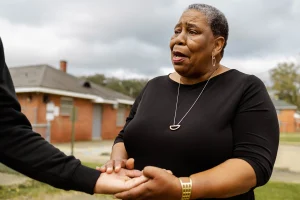
Jo Ann Bland, from Selma, joined the Student Nonviolent Coordinating Committee (SNCC) at just eight years old. By the time she was 11, she’d already been arrested at least 13 times for nonviolent demonstrations challenging Jim Crow laws and racial segregation. In 1965, she participated in Bloody Sunday, a march that helped lead to the passage of the Voting Rights Act of 1965. Bland would become the co-founder of the National Voting Rights Museum and Institute. She passed away in her beloved Selma, on February 19.
For Bernard LaFafayette Jr., Ed.D., his ties to Alabama began in the early 1960s, too. Back then, he and John Lewis, of Troy, were roommates at American Baptist Theological Seminary, in Nashville. Through their leadership roles in SNCC, LaFayette and Lewis would help lead the Freedom Rides of 1961. LaFayette’s leadership was critical as director of SNCC’s Alabama voter registration project in Selma. He would continue to work closely with Martin Luther King Jr., including as national coordinator of the Poor People’s Campaign at the time of King’s assassination. LaFayette passed away on March 5, in Tuskegee.
Below, AHA friends Martha Bouyer, D.Min., Mark Wilson, Ph.D.; and Dorothy Walker share memories of these two titans of Alabama’s civil rights history.
Dr. Bouyer is an educator, civil rights scholar, and an AHA Alabama Humanities Fellow. She has led various versions of ‘Stony’ for AHA through the years, drawing on her experience as executive director of the Historic Bethel Baptist Church Community Restoration Fund.
“What a fellowship, what a joy divine!”
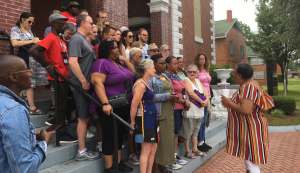
When I think of Jo Ann Bland, words from this song come to mind. Jo Ann and I first met at a meeting with Priscilla Hancock-Cooper at the Birmingham Civil Rights Institute. At the time, she was working with Rose Sanders at the National Voting Rights Museum. At first, I thought she was so quiet and reserved. Was I ever wrong about her!
Jo Ann, master teacher, storyteller, historian, and friend. I remember when she met with over 20 teachers through the “Stony” teacher project I developed with AHA. Jo Ann and I worked with teachers from across the nation and around the world to help them understand the complexities of living life in a Jim Crow society.
She challenged all of us to take this story of ordinary people standing up in the face of certain danger for the right to vote. Jo Ann emphasized the importance of saying “I have a Dream.” Even if the dreamer had been murdered, the dream was still alive. Words mattered and she wanted the children who lived in George Washington Carver Homes, as well as the thousands of people who came to literally sit at her feet, to learn the history and get it right.
I am so glad that I got to work with this amazing woman on the National Park Service documentary Never Lose Sight of Freedom. Through the magic of technology, her voice will continue to ring out and bring hope to the hopeless. Countless students will understand what it means to take a stand for the right and to do something to correct a wrong.
I was so sad to hear of Jo Ann’s death, but I thank God that she lived. During our Stony institute, as we stood with her on the steps of Brown Chapel or scurried around to find a rock in the playground, she commanded our attention and encouraged us to teach the history of Selma. To stand for right, freedom, justice, and equality. I thank God that I got to call her my friend.
Dr. Wilson is an author, historian, and director of the Caroline Marshall Draughon Center for the Arts & Humanities at Auburn University. A frequent AHA project scholar, he also serves as secretary of the Alabama Historical Association.
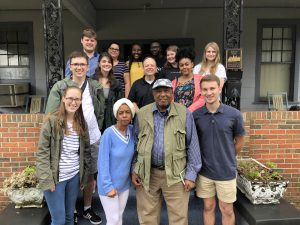
For several years starting in 2017, Dr. LaFayette worked with the Draughon Center as a Breeden Eminent Visiting Scholar, and he co-taught courses on leadership and civic engagement. He also made countless class visits to share his unique life experiences related to the civil rights movement, teaching nonviolence around the world, and adventures galore.
Bernard modeled reflection on the human experience better than anyone else, and his commitment to nonviolence and Martin Luther King’s final words to him (“…to institutionalize and internationalize nonviolence”) resonate as much today as they did in 1968.
As we mourn his passing, I hope people who haven’t heard his stories will find them online, considering what the power of nonviolence might mean in our lives and nation today. (You can also read Dr. LaFayette’s story directly in his own words, through his book, In Peace and Freedom: My Journey in Selma.)
Walker retired from the Alabama Historical Commission in 2024 as site director for Montgomery’s Freedom Rides Museum. She now is a program officer the U.S. Department of the Interior and is on the board of the David Mathews Center for Civic Engagement. This memory comes from her story in AHA’s Mosaic magazine in 2021, on the Freedom Rides of 1961: “The power of place, memory, song.”
My favorite thing to do is to humanize the Freedom Riders. If people know the story at all, they usually come with this visual in their head of this large group of people. Freedom Riders who are mostly nameless and faceless. So, I tell visitors the names and their stories. I show them faces. I remind them that a lot of the Freedom Riders were 18-, 19-, 20-year-old kids…
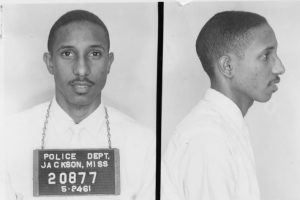
I tell them about Dr. Bernard Lafayette, a Freedom Rider who also organized sit-ins during the Nashville Student Movement. He tells a story of a sit-in at a lunch counter where this guy holds up a lighter to the hair of a female student. Dr. Lafayette could smell it smoldering. He doesn’t get violent, but he puts his hand over her head and tries to put it out.
Dr. Lafayette recalls the student turning to him, giving him this very serious look, and saying: “Please do not interfere with my suffering. My suffering is what people have to see for change to happen.”
…The few times that Freedom Riders were asked if they wanted to press charges against their assailants, they said: “No, that’s my brother, that’s my sister.”
For more on this era of Alabama history, listen to AHA’s 2021 podcast series, Black Alabamians and the Vote.
Birmingham, AL
September 21, 2023
Birmingham / September 1, 2023 — Through the first half of 2023, the Alabama Humanities...
Birmingham, AL
July 5, 2022
[BIRMINGHAM / July 5, 2022] — In advance of The World Games in Birmingham, the...
Birmingham, AL
August 16, 2023
BIRMINGHAM / August 16, 2023 — A pair of Alabama natives, widely acclaimed for their...