
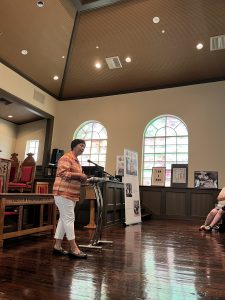
 Last Wednesday, educator Cynthia Jackson sat in a pew at Birmingham’s historic Bethel Baptist Church, speaking quietly with Rev. Carolyn McKinstry, D.Div., a beloved author and minister who, as a teenager, had survived the 16th Street Baptist Church bombing.
McKinstry had just spoken before a group of Alabama teachers, sharing about her childhood in Birmingham during the civil rights movement. Now, Jackson was talking directly with this inspiring foot soldier, a conversation swirling around Alabama’s past, present, and future.
“When my kids, my students, get to asking questions, how wonderful will it be when I can tell them, ‘well, I actually got to talk with Dr. Carolyn McKinstry, who survived the 16th Street Church bombing, and here’s what she told me,’” says Jackson, who teaches at W.F. Burns Middle School in Chambers County. “This is a living experience that I’ll be able to draw on when I’m back in the classroom. This is incredible.”
Stony the Road
Jackson was one of the educators participating in the Alabama Humanities Alliance’s summer field study, Stony the Road We Trod: Exploring Alabama’s Civil Rights Legacy. The immersive, residential experience enables Alabama K-12 teachers to visit sites of conscience, meet foot soldiers of the movement, and discover new resources and ideas for the classroom. Teachers selected for the workshop came from cities big and small — from Huntsville to Northport, Parrish to Opelika, and points in between.
View a photo album from Stony 2025.
Highlights of Stony 2025 included visits to:
- Alabama Department of Archives and History
- Alabama State Capitol
- Bethel Baptist Church, Birmingham
- Birmingham Civil Rights Institute
- Civil Rights Memorial Center
- Edmund Pettus Bridge in Selma
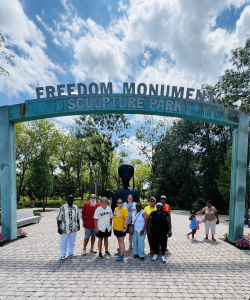
- EJI Legacy Museum, National Memorial for Peace and Justice, and Freedom Monument Sculpture Park
- The Judge Frank M. Johnson Jr. Institute
- Rosa Parks Museum at Troy University
- Selma to Montgomery National Historic Trail
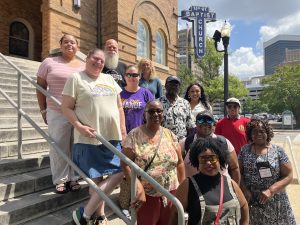
- Sixteenth Street Baptist Church, Birmingham
 Along the way, teachers visited archives to identify primary resources they could use in the classroom. On the final day of the residency, teachers even crafted potential new lesson plans and then presented them to each other for peer feedback.
“Stony the Road is a professional learning treasure for our state educators,” says W. Blake Busbin, Ph.D., Course of Study Administrator and Social Studies Education Specialist for the Alabama State Department of Education.
“The life-changing experiences it offers to its participants reveal the stories of people, places, and events that not only shaped local communities and Alabama but furthered America’s commitment to its 1776 promises contained in the Declaration of Independence,” Busbin notes. “The combination of content knowledge and pedagogy provided in the learning experience equips Alabama teachers to be leaders in teaching this integral history.”
 Stony’s project director is Martha Bouyer, D.Min., an educator and civil rights scholar who was named an AHA Alabama Humanities Fellow in 2018. Dr. Bouyer has led various versions of Stony for AHA through the years, drawing on her experience as executive director of the Historic Bethel Baptist Church Community Restoration Fund.
“This kind of story-sharing is sort of the art of showing people why they should care about a thing,” Bouyer says. “That is where the humanities live, helping us to be in touch with the things that impact our lives.”
Bringing Stony back to the classroom
Teachers selected to participate in Stony received a stipend, professional development credits, and new resources for the classroom — including a half-dozen new books.
Participant Cynthia Jackson noted that each teacher received those books far in advance of the workshop, preparing her for what she’d see up close during Stony — and providing a rare chance to then speak with a few of those authors in person during the week.
Jackson even made a personal connection with scholar Hasan Kwame Jeffries, Ph.D., a history professor and author who gave a presentation on expanding the stories of the civil rights movement. Dr. Jeffries wrote Bloody Lowndes, about the 1960s freedom movement in Alabama’s Black Belt.
“When I was reading his book, one of the names I saw jumped off the page,” Jackson says. “Dr. Jeffries had actually interviewed one of my relatives, who lives in Lowndes County. So, I had the chance to talk with Dr. Jeffries about that and to share stories with each other about our Lowndes County connections. Getting to interact with authors like that is wild. It’s such an invaluable part of this experience.”
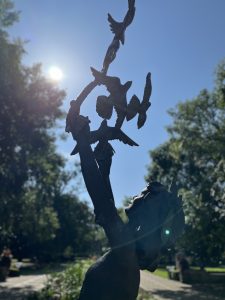 Stony indeed dives deeply into Alabama’s civil rights legacy. The residency isn’t just a primer for newer teachers of this history. It’s also a boost for the most experienced of educators.
Kristina Godsey, of Parrish, Alabama, teaches at Fairfield High Preparatory School. She’s taught for 20 years and serves as her school’s social studies chair.
“I signed up for this because there’s always something new you can learn,” she says. “The more I immerse myself in something, the more I’m going to understand it. What we’re doing here makes civil rights history personal, human. And when you look at it that way, and can teach it that way, it really resonates.”
Making Stony 2025 possible
The Alabama Humanities Alliance has now presented Stony at least a half-dozen times. This year, the nonprofit and nonpartisan organization is more appreciative than ever for all who made the experience possible.
 Back in April, the U.S. Department of Government Efficiency terminated AHA’s 50-year partnership with the National Endowment for the Humanities — and, with it, two-thirds of our annual budget. For more than half a century, AHA had used federal dollars appropriated by a bipartisan Congress to support statewide grantmaking and programming such as Stony and AHA’s beloved Road Scholars Speakers Bureau.
“This spring, we feared we would have to cancel this unique opportunity for Alabama’s teachers,” says Chuck Holmes, AHA’s executive director. “Thankfully, we didn’t have to do that because of generous contributions from individuals and institutional donors statewide, who value Alabama’s history and Alabama’s educators. We are so grateful to them all for ensuring Stony could proceed.”
The Alabama Humanities Alliance still has a long way to go to find sustainable funding that will ensure its grantmaking and public programming continue beyond 2025. To support the future of Alabama Humanities, donate at alabamahumanities.org/support.
About the Alabama Humanities Alliance
Founded in 1974, the nonprofit and nonpartisan Alabama Humanities Alliance has served as a state affiliate of the National Endowment for the Humanities. Through our grantmaking and public programming, we promote lifelong learning, impactful storytelling, and civic engagement. We believe the humanities can bring Alabamians together and help us better understand the communities we call home. Learn more at alabamahumanities.org.
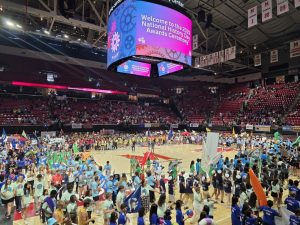 “There may not be a more inspiring showcase of students’ brilliance and curiosity in this state,” says Idrissa N. Snider, Ph.D., program coordinator for the Alabama Humanities Alliance. “Alabama History Day brings hundreds of students together to share their passion for learning about our past. These students are more than historians, too. They are authors, artists, filmmakers, web designers, and dramatic performers who have the freedom to choose their topics and share their research in creative ways.”
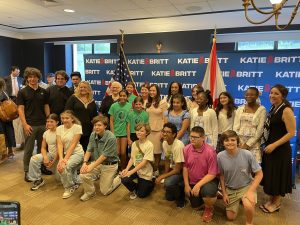 For Alabama students who advance to National History Day, the experience comes with the opportunity to visit Washington, D.C.. These memory-making visits to Capitol Hill give our students a chance to see the halls of our democracy up close — and to talk about their History Day projects with their members of Congress.
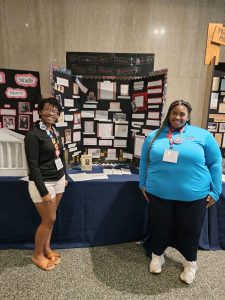 This year’s D.C. day also involved some work for a pair of Alabama students. Lexington Bush and Jayde Robinson, of Mobile’s Murphy High School, were selected to present their exhibit at a “Smithsonian Showcase” at the National Museum of American History. Museum visitors had the chance to see these students’ work and ask questions about their research on “The Literary Legacy of African Americans During the Harlem Renaissance.”

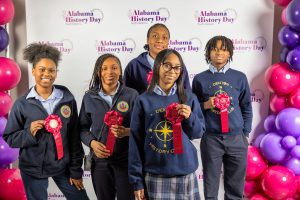 Matt Spivey is the academic supervisor for social studies at Mobile County Public Schools, and a partner in organizing the South Alabama regional. He noted that the History Day program has obvious immediate impacts in terms of helping students build critical thinking skills, and in vetting and analyzing sources — “and in all those elements that will benefit our students in their classes, in those high-stakes tests that we use to measure their progress.”
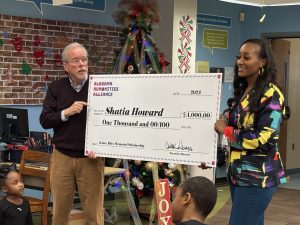
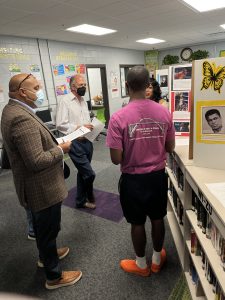 The 10-week Writing Our Histories pilot program culminated in an Alabama History Day contest on October 4, on the Mt. Meigs campus. Students presented their research as exhibits that colorfully highlighted what they’d learned on topics ranging from World War II and the Civil War to Alabama athletes and the civil rights movement. Students confidently and enthusiastically talked about what they’d learned, answering questions from Alabama History Day judges who work professionally as educators, historians, and authors. Teachers from other DYS campuses also attended to observe and bring the experience back to their own classrooms.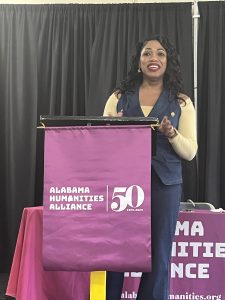

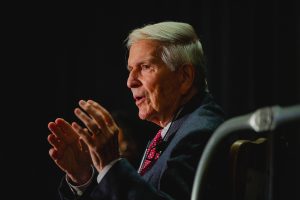 “Today, David Mathews is receiving the highest humanities honor in the state because he sees diverse communities, rich cultures, and fellow neighbors more clearly and with more empathy,” Randall said. “He provides context that helps us better understand our past and our present…His scholarship and public service in pursuit of community-building and deliberative democracy represent the best of the humanities.”
 “It means the world to me,” Perry responded. “I have traveled far and been educated at lots of fancy places, but everything that I have carried with me that has enabled me to move with integrity and diligence and rigor and deep love of people — which is at the heart of the humanities — comes from this soil and my family. This means so much. There’s nothing in the world like being celebrated at home.”
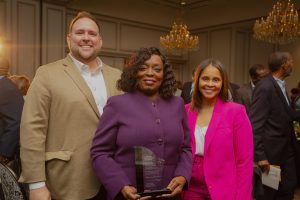 Other honorees recognized at the 2023 Alabama Colloquium included: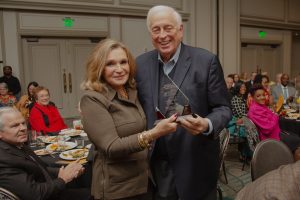
 Mathews’ legacy is evidenced in Alabama at the David Mathews Center for Civic Life, which seeks to strengthen civic engagement statewide. While president at UA, he also played a significant role — along with his counterpart at Auburn, Harry Philpott — in helping to found what is now the Alabama Humanities Alliance.